Waking Up at 3AM: Meaning, Chinese Body Clock, and What To Do Right Now
Two sleep cycles end near 3 and cortisol starts climbing — common physiology, not something broken. Same hour every night = a pattern that can be read.

Updated Jul 10, 2026
✓ 60-day guarantee — if the Map tells you nothing of your own, full refund
The organ clock: tap your hour
This is the map of the Chinese body clock, shown for what it is: a tradition. Each two-hour band is linked to an organ. Tap yours and you'll see, in order, the legend reading (indigo), the physiological reading for that band (gold, with a source), and what to do right now.
the page follows the sky of the hour you touch ☾
Does it happen often, at the same hour? The bruxo will put together the reading for YOUR hour — your band, your pattern, what to watch — and send it to your inbox. You can reply and talk it through with him.
The Natal Map of the Body
It finds your weak hour — and why. It tells you what holds each season. 26 pages. Your name on every one.
Your Map tells you which is YOUR weak hour and why: your chronotype, the band where your rest grows thin, and the ritual that holds each season. 26 pages, yours to keep.
A clinical astrology + naturopathy session: $80–150 · the Map at opening: $19
forged one at a time — the bruxo writes each Map alone, start to finish
You came through the 3 AM door — so the Map opens on your nights first.
Get my Map — $13.40Secure checkout by ClickBank — card or PayPal. Your Map lands in your inbox within 24 hours.
Not medical advice. For personal reflection and wellbeing. Astrology and the organ clock are presented as declared tradition, never as science.
This is how a Map is born
These are pages from a Map already forged — someone else's, with their name on it. Yours will speak of you: your hours, your body, your seasons.
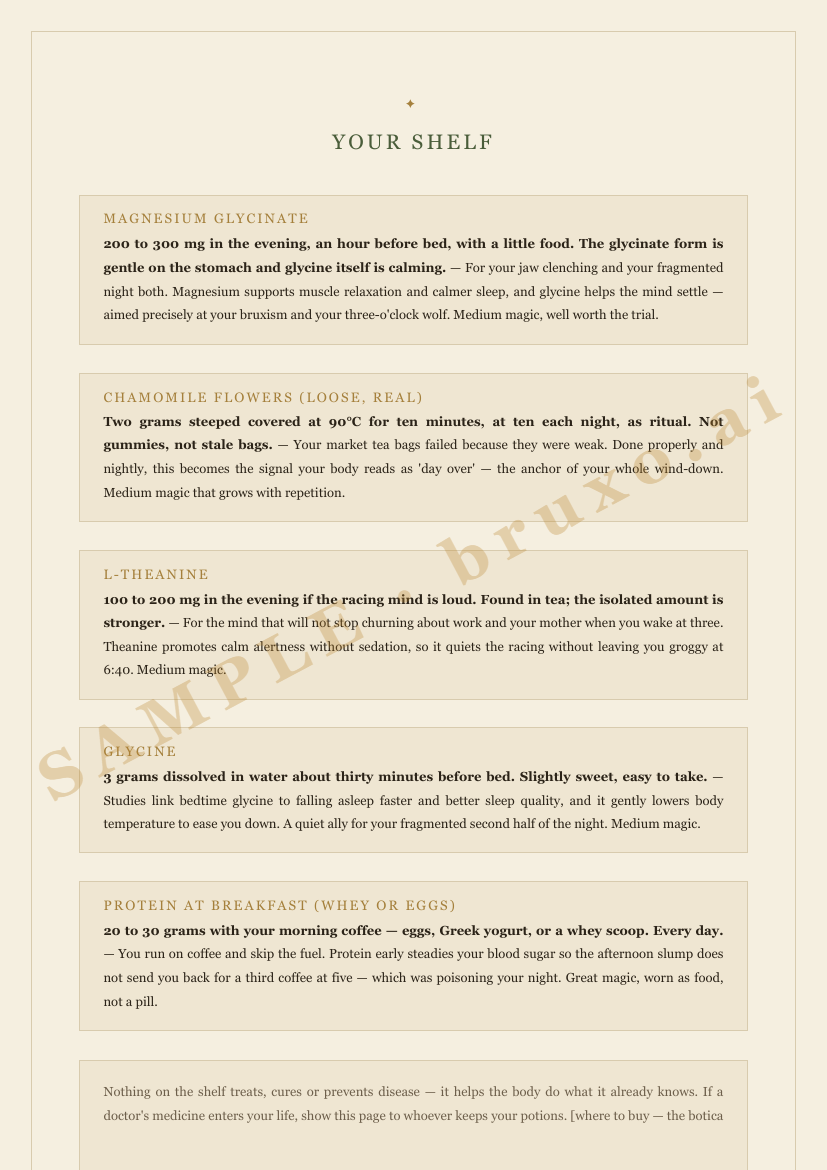 26 pages — yours will speak of you
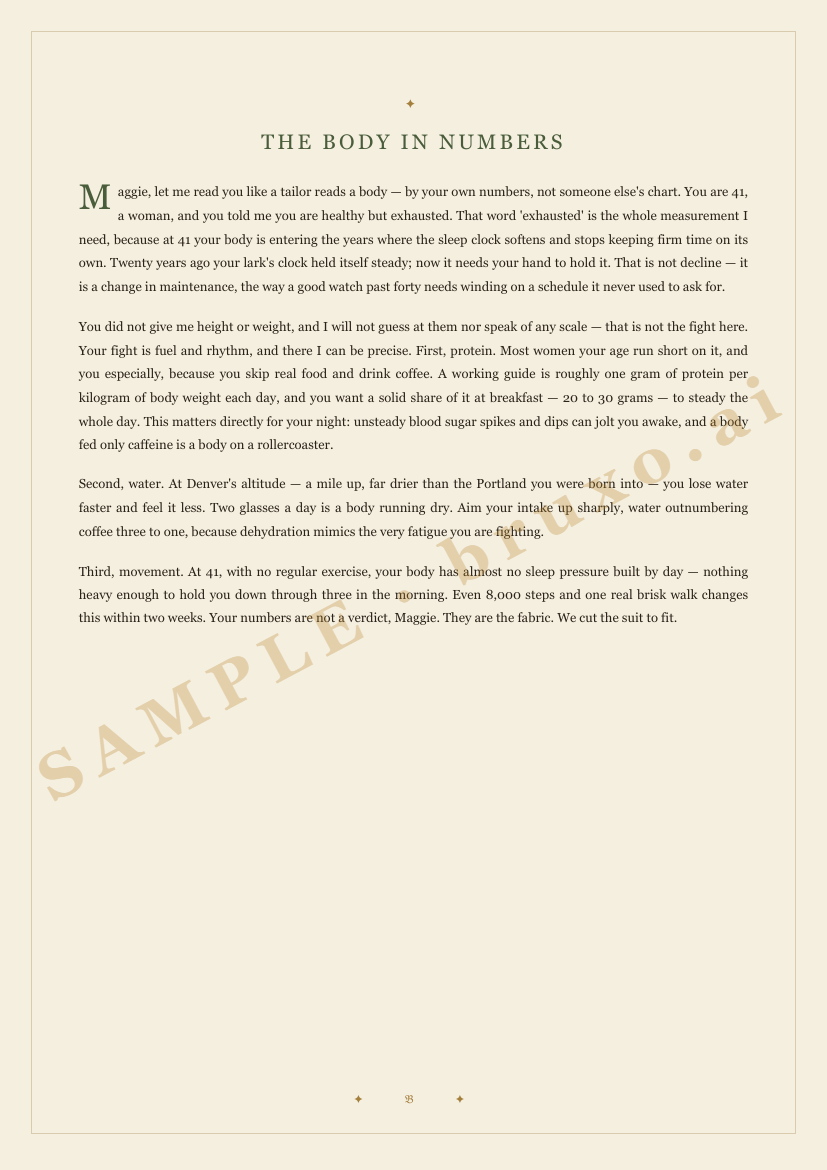 26 pages — yours will speak of you
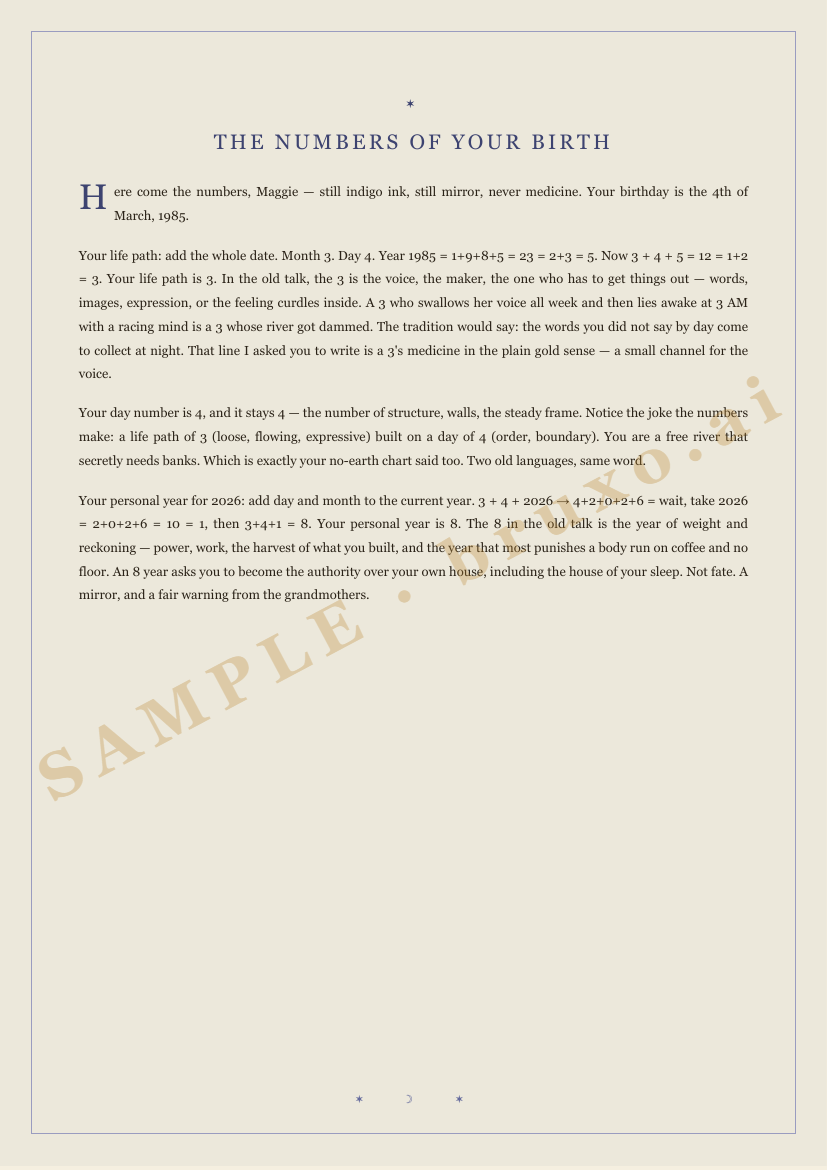 26 pages — yours will speak of you
Tap the first two to look closer. The rest stay veiled: they belong to whoever ordered them.
You woke at 3 and your head started on its own. First, the short answer: by that hour you've closed about two sleep cycles, slid into a lighter stage, and your body has begun raising cortisol to get you ready for the day. A brief wake-up there is normal. What makes it long is almost never the body — it's the mind grabbing a thought and refusing to drop it.
There are three ways to read the same waking, and on this page I keep them apart on purpose. The legend calls it the hour of the soul: the quietest stretch of the night, the one many traditions filled with meaning. The Chinese body clock — also tradition — gives each two-hour band an organ: 1 to 3 the liver, 3 to 5 the lung. And the physiology explains, with data, why 3 in particular is so easy to open your eyes at.
Indigo is legend. Gold is science with a source. I don't mix them, and I always tell you which one you're reading. Let's take the honest answer from each.
In many traditions, 3 to 5 AM is "the hour of the soul": the most silent, when the veil between inside and outside is said to grow thin. It isn't a medical truth; it's an old frame for naming something almost everyone feels at some point.
Near waking time, cortisol rises naturally — the cortisol awakening response — and readies the body for the day; at the same time, the second half of the night holds more light sleep and more dreaming, so waking there is more likely. (Clow et al., 2010, review of the cortisol awakening response)
3:12, the ceiling, and the mind that starts up
You know it by heart. You open your eyes, check the clock: 3:12. The room silent, the ceiling above you, and in one second your head is already at tomorrow's meeting, at that thing you said, at the bill you still owe. You weren't thinking about anything, and now you're thinking about everything. And tomorrow you have to show up.
Counting sheep doesn't work — your head is far too awake for a trick that thin. And checking your phone makes it worse: the light tells your brain it's daytime and cuts the little melatonin you had left. You already know this, and still your hand reaches for the phone. It isn't weak willpower; at that hour the brakes are simply low.
Now, the question that changes everything: do you wake at the same time every night? If it's almost always 3, or almost always 4, that isn't random. It's a pattern. And patterns can be read. Sleep moves in cycles of about ninety minutes; if you go to bed around the same time, your light stages land around the same time. Tap the hour that wakes you below and see what each layer says.
The legend of 3AM, with respect
Almost every culture named this waking. You don't have to believe it to listen: these are old ways of saying the small hours are different, and of giving a place to what we feel when the world sleeps and we don't.
In several Christian traditions, the pre-dawn hours were tied to vigil and prayer; the idea of a "devil's hour" near 3 is more modern folklore than doctrine, but it shows how heavily that band sits in the imagination. In contemplative thought, the stillness before dawn was seen as the best moment to listen inward. And the Chinese body clock, which you'll see in detail below, is another — far older — way of saying that every hour of the day and night has its own color.
Here's how I hold it: the legend doesn't explain your cortisol, and it doesn't try to. It explains why the 3AM waking feels so loaded. That weight is real even when its cause is physiological. Naming it with an old story sometimes loosens the knot faster than any data does.
"The hour of the soul isn't for solving your life. It's for being awake a while with yourself, fixing nothing, until sleep comes looking for you again." That's how the grandmothers tell it, and it isn't a bad thing to listen to them.
The organ clock, band by band
The table lays out all twelve bands the way the body clock tradition presents them. The "what to watch" column is mine: a short physiological reading so the tradition doesn't stand alone. Remember: this is a frame for self-reflection, not a diagnosis.
| Band | Organ (tradition) | Traditional reading | What to watch (physiology) |
|---|---|---|---|
| 23–1 | Gallbladder | Deciding; the courage remade at night | First deep-sleep cycles, the most restorative |
| 1–3 | Liver | Storing the blood; processing the unsaid | The alcohol-rebound band, if you drank |
| 3–5 | Lung | The hour of the soul; breath and grief | Cortisol rising, light sleep, more dreams |
| 5–7 | Large Intestine | Letting go of the day before | Natural cortisol peak near waking |
| 7–9 | Stomach | Nourishing the day that begins | Peak morning alertness; waking here is normal |
| 9–11 | Spleen/Pancreas | Turning food into clarity | Focus peak for many chronotypes |
| 11–13 | Heart | Joy, connection, the shared table | Slight dip in alertness before afternoon |
| 13–15 | Small Intestine | Sorting the useful from the excess | The post-lunch dip, real and universal |
| 15–17 | Bladder | The body's water, the day's stamina | Good window to move: strength near its peak |
| 17–19 | Kidney | The vital reserve, the root of energy | Coffee now can still be in you at bedtime |
| 19–21 | Pericardium | Guarding the heart, intimacy | Melatonin starts rising as light drops |
| 21–23 | Triple Burner | Balancing the systems before rest | Ideal sleep window for most people |
The science of night waking
Here I switch ink. Everything that follows is physiology with a source. Four pieces explain almost every 3AM waking, and none of them is a disease: they're the normal workings of a human body at night.
1. Sleep architecture. You sleep in cycles of about 90 minutes. In the second half of the night those cycles carry more light sleep and more dream stage; by 3 you've closed nearly two full cycles, so you're in the territory where a noise, a full bladder, or a thought can pull you out. (Carskadon & Dement, 2011, normal sleep architecture)
2. Pre-waking cortisol. Cortisol doesn't fire only when your eyes open: it starts climbing in the last hours of sleep and reaches its natural peak shortly after you wake. That climb makes you easier to rouse right in the small hours. It's the mark of a healthy body, not an alarm. (Fries et al., 2009, cortisol awakening response)
3. The alcohol rebound. One drink too many helps you fall asleep but fragments the second half of the night: as the body finishes clearing the alcohol, a rebound effect tends to wake you between 1 and 4. Easing off evening alcohol settles that band a great deal. (Ebrahim et al., 2013, alcohol and sleep)
4. A nighttime sugar dip. In some people, a drop in blood sugar in the small hours triggers counter-regulatory hormones — adrenaline, cortisol — to correct it, and that can wake you. Eating very little or very early can nudge it along in certain bodies. (review of nocturnal hypoglycemia)
I wake at four too, almost always the same night of the week. At first I fought it. Then I understood my body was doing its job, and the problem was the fight, not the waking. What changed my small hours wasn't a magic tea — it was stopping treating the waking like an emergency.— the bruxo, from the apothecary
When to talk to a doctor
I'll be honest, because honesty is what this calls for. Almost all 3AM wakings are normal and settle with habit and calm. But there are signs where the doctor is the thorn of the remedy, and skipping them isn't brave, it's foolish. Get care if:
- You wake gasping, short of breath, or with your heart pounding, or your partner notices you stop breathing and snore loudly: it can be sleep apnea, and that gets investigated and treated.
- The distressed small-hours waking repeats for more than three weeks and wrecks the next day.
- It comes with persistent sadness, loss of interest, or dark thoughts: that isn't managed alone.
- You have diabetes or take blood-sugar medication and suspect nighttime lows.
Nothing on this page replaces that visit. The bruxo walks alongside; he doesn't diagnose.
If you wake without breath, don't ask me first: go to the doctor. I'm here for the small hours when the body is fine and the head won't loosen. That, I can help with — and there, I replace no one.— the bruxo, from the apothecary
How the bruxo works
There are no invented testimonials on this page, and there won't be. In their place, the way I work:
- I say "I don't know" when I don't know. The small hours are part mystery, part physiology; I don't confuse one for the other.
- Indigo is legend, gold is science. I never use a tradition to pretend it's a study.
- The doctor first when there's a warning sign. I'd rather lose you as a consultation than have you ignore something serious.
- I promise to cure nothing. I support your rest; I don't treat diseases or sell miracles.
Questions that reach the apothecary
Why do I wake up at 3AM and can't fall back asleep?
What organ is active at 3AM in the Chinese body clock?
Is waking up at 3AM anxiety?
Why do I always wake up at the same time?
Does alcohol make me wake up in the middle of the night?
What should I do when I wake up at 3AM and can't sleep?
From the same shelf
- Tea for sleep: 7 herbs and what each one is for
- Herbs to support cortisol across the day
- Can't sleep, racing mind: what to do tonight
- Birth chart calculator (and of the body)
- Leave your email and get into the apothecary first
So now you know what the tradition reads in the 3am hour — which window opens, and why it keeps opening at the same time.
But a page like this can only speak in general — it describes the night, not yours. Which hours run strong in your own body, which remedy fits your constitution — that reading starts from your birth data, and it is the Map of the Body: 26 pages written on your chart alone, yours for good.
The night has been explained. Yours is still waiting to be read.
Open my Map — $13.40Secure checkout by ClickBank · 60-day guarantee · no rush: the apothecary door doesn’t close.