Can't sleep, racing mind: what to do right now
It's the middle of the night. You can't sleep. That's okay — stay here for 20 minutes.

Updated Jul 10, 2026
The long exhale pulls the body's vagal brake — the nerve that tells the heart "slower now." (slow breathing and heart rate variability — PubMed)
We are not going to fix your life at this hour. Nothing gets fixed at this hour.
We'll do something smaller: bring the body's revs down, take what the head is carrying out of it, and leave a door open in case you want to talk. Twenty minutes. That's all.
The next 20 minutes
Eight rounds of the circle above
Stay with the circle. Eight rounds take about two and a half minutes. Four seconds of air in through the nose. Seven holding. Eight letting go through the mouth, slowly, like fogging up a window.
It isn't magic. It's mechanics: when the exhale is longer than the inhale, the pulse comes down on its own.
A little lightheaded at first? Normal. Breathe normally for a moment and come back.
Paper and three lines
Dim light. Real paper, not your phone. Write three lines:
what is keeping you awake,
the one thing you will do about it tomorrow,
what part of it is not up to you.
Three lines. No prose. Fold the paper and leave it away from the bed.
The old healers said the head only lets go of what someone wrote down: a thought handed to paper is no longer yours to carry. It's legend — and it makes a good ritual.
Writing tomorrow's to-do list before lights-out helped people fall asleep faster than writing about what was already done. (Scullin 2018, n=57)
If 20 minutes pass and nothing
Don't stay in bed fighting. Get up. Dim light, another room if you have one. Do something genuinely boring: fold laundry, leaf through a manual, tidy a drawer. No screens.
When your eyes get heavy, go back to bed — and only then. That way the bed never becomes the enemy: it's for sleeping, not for arguing with the ceiling.
Leaving the bed when sleep won't come is part of "stimulus control," one of the best-evidenced components of behavioral treatment for insomnia. (PubMed)
The bruxo's door
If after all this the head is still talking, don't quiet it alone. There's a door just below. It doesn't open yet, but you can leave your name on it.
Why the mind speeds up the moment you turn off the light
It isn't bad luck. It's design.
All day, your attention jumps from thing to thing: messages, work, people, noise. Each jump covers the last one. When the light goes off, the last distraction goes with it.
And the brain has a network that switches on precisely when there is nothing to do. It's the one that replays conversations, builds lists, argues with people who aren't there.
If the day had not one single pause — not one — the night collects that debt in full. The first quiet moment in sixteen hours is your pillow. The mind doesn't "race" at night: you finally hear it.
That network has a name: the default mode network. It activates when the brain runs out of external tasks; in heavy ruminators, it works overtime. (default mode network and rumination — PubMed)
The old folks put it another way: night is when the soul takes attendance. Legend, not science — but it names the feeling well.
What doesn't help (even if the body begs for it right now)
Checking the time every five minutes. Every glance is a subtraction: "four hours left," "three and a half left." A countdown is the opposite of sleep. Turn the clock around.
The phone. It's not just the light: it hands the mind exactly what it's asking for — more things to chew on. A racing mind doesn't need more fuel.
Arguing with yourself. At 3 a.m. you lose every argument against yourself. A tired brain enlarges the bad and hides the good. Simple rule: nothing thought after midnight gets signed. It gets reviewed in daylight.
I keep night hours because I know this hour. The small hours weigh double and you weigh half. I don't know why that is — nobody fully does. I know this: no 3 a.m. thought arrives intact at 10 in the morning. Write it down, let it go, and if you want, tell me.— the bruxo, from the botica
If it's like this almost every night
Anyone can have one bad night. A strange week, too.
But if this repeats almost every night for more than three weeks, or if you no longer function during the day — nodding off at work, driving scared — that is no longer a matter for rituals or teas. It's a matter for a doctor. That's the thorn in this remedy, and we say it to your face.
The good news: there is a behavioral treatment, CBT-I, with more long-term evidence than any pill. Ask about it. This page doesn't diagnose or treat anything: it keeps you company through a hard night.
On being awake while everyone sleeps
One more thing, best said plainly: the small hours are lonely. The house silent, the world switched off, and you with the only light on. That loneliness makes everything weigh more than it does.
You are not as alone as it feels. At this very hour, in your own city, thousands have a light on. They just can't see each other.
And if what shows up at this hour isn't a worry but a heavy distress — one that returns night after night and won't loosen — that deserves more than a web page. Talk to someone real.
In the US, you can call or text 988 any time, free. Other countries have their own lines — searching "crisis line" plus your country is enough.
This is how a Map is born
These are pages from a Map already forged — someone else's, with their name on it. Yours will speak of you: your hours, your body, your seasons.
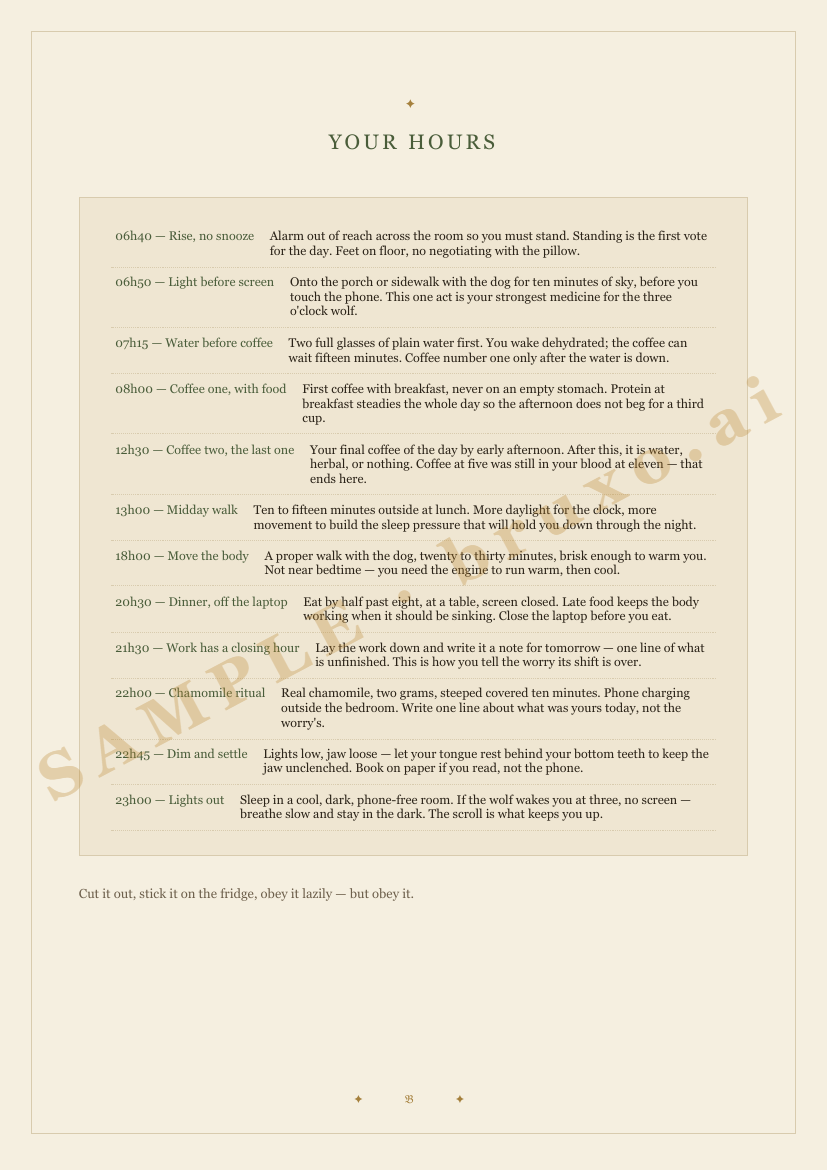 26 pages — yours will speak of you
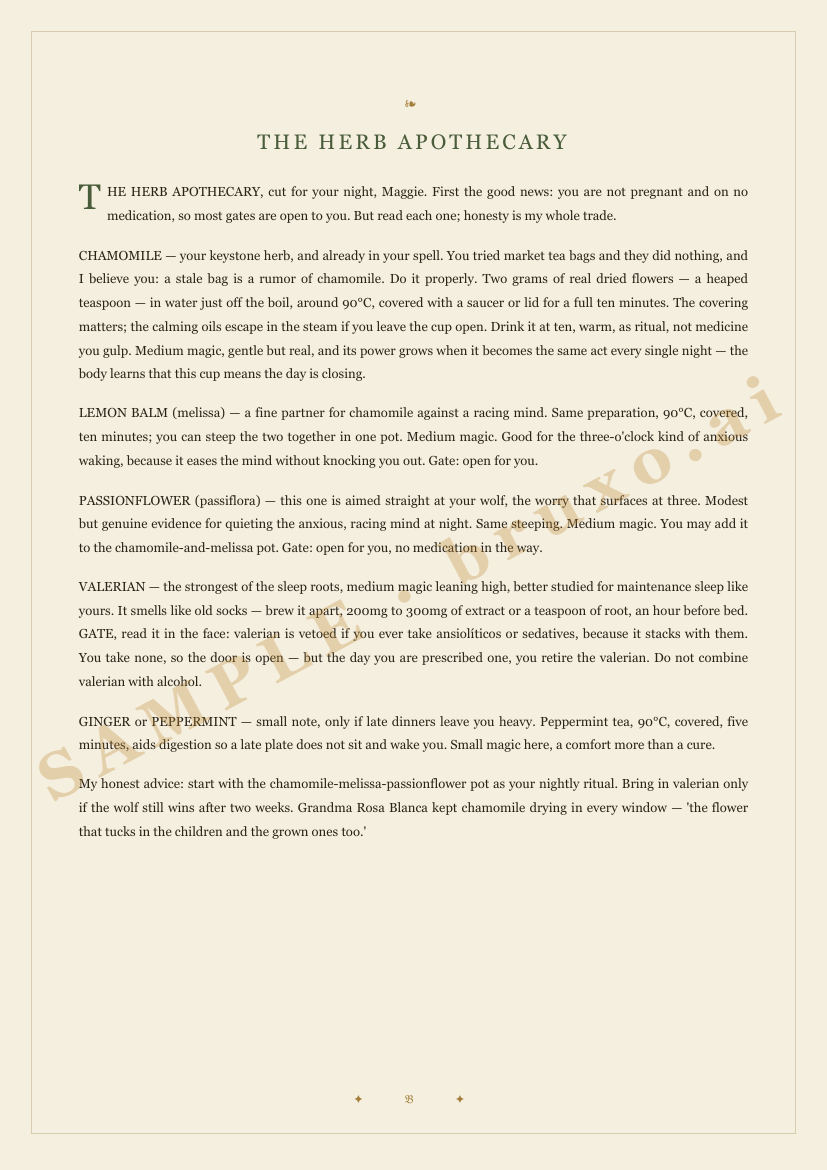 26 pages — yours will speak of you
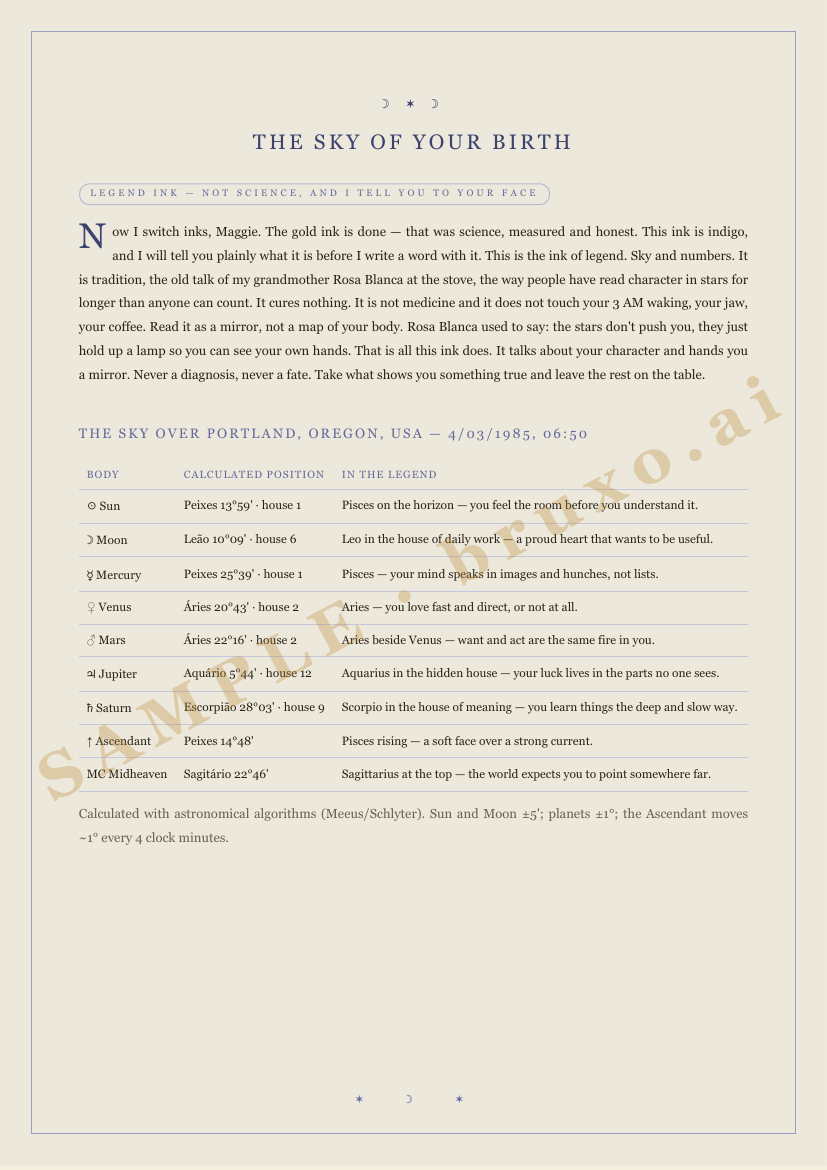 26 pages — yours will speak of you
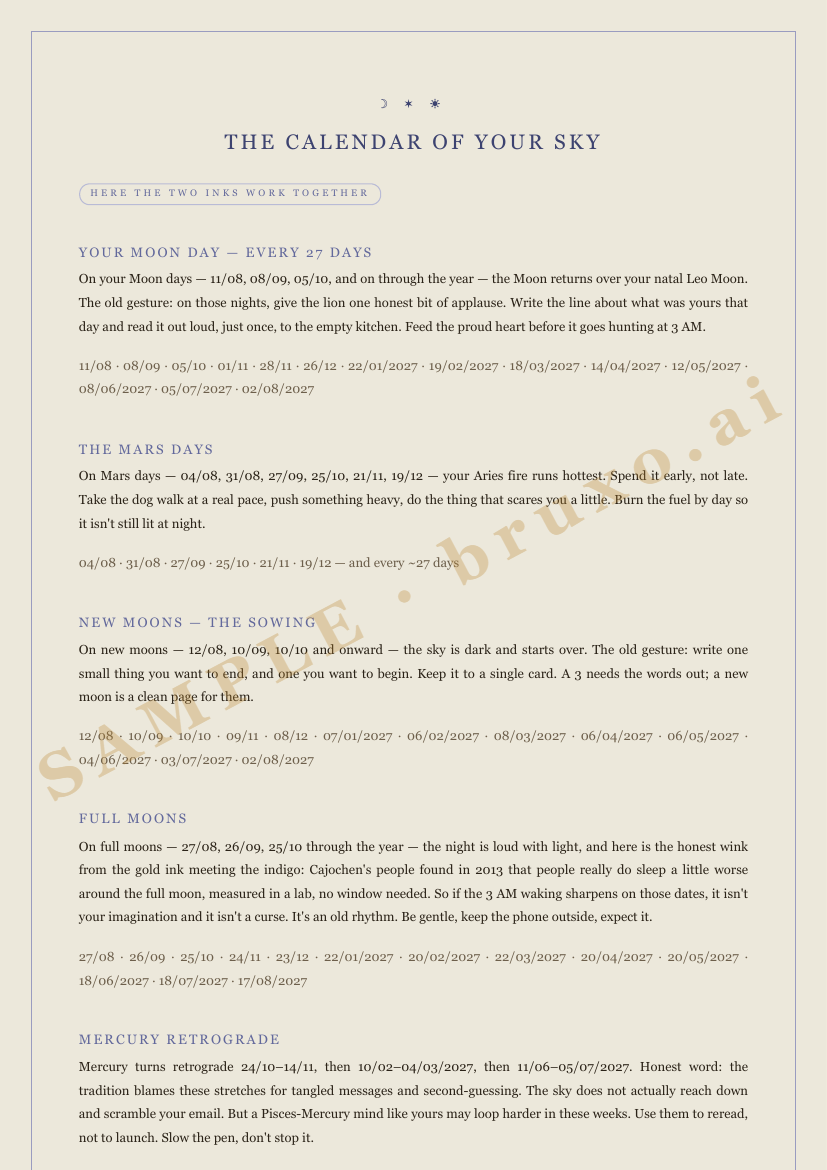 26 pages — yours will speak of you
Tap the first two to look closer. The rest stay veiled: they belong to whoever ordered them.
The apothecary is home to the Natal Map of the Body — 26 pages on your hours and your rest, drawn from your birth chart. $13.40, founder's price. But it is not for this hour: the apothecary door never closes, and tomorrow, in daylight, it will still be there.
Questions that reach the botica
Why does my mind start racing the moment I turn off the light?
Does getting out of bed actually help when I can't sleep?
Will 4-7-8 breathing put me to sleep?
When should I see a doctor about not sleeping?
From the same shelf
Not medical advice. For reflection and personal well-being. When astrology appears in the botica, it is declared tradition — never science.
If you made it this far, the breathing has already done half the work.
When it's daylight and you want to know the hours when your body truly rests, the Map will be waiting in the apothecary — no rush: that door never closes.