Which magnesium should you take?
For rest: glycinate. For slow transit: citrate. The oxide on the shelf barely absorbs. The tree below picks yours.

Updated July 10, 2026
✓ 60-day guarantee — if the Map tells you nothing of your own, full refund
Which form is yours? The bruxo's decision tree
Three questions. At the end: the form, the typical dose, which meal to pair it with, and what to honestly expect in weeks 1, 2 and 3.
What do you want it for?
The Natal Map of the Body
It finds your weak hour — and why. It tells you what holds each season. 26 pages. Your name on every one.
The tree tells you which magnesium. Your Map reads the fuller question: whether your night is asking for magnesium at all — or for an earlier dinner, a darker room, a different hour — and at what time your body actually wants to wind down. 26 pages, built from your birth data and your answers. Yours forever.
An astrology-plus-naturopathy consultation: $80–150 · the Map at opening: $19
forged one at a time — the bruxo writes each Map alone, start to finish
You came through the remedies door — so the Map opens on your nights first, herb by herb.
Get my Map — $13.40Secure checkout by ClickBank — card or PayPal. Your Map lands in your inbox within 24 hours.
Not medical advice. For reflection and personal well-being. Astrology is offered as declared tradition — never as science. Supplement statements describe support for normal function and have not been evaluated by the FDA; this page does not diagnose, treat, cure or prevent any disease.
This is how a Map is born
These are pages from a Map already forged — someone else's, with their name on it. Yours will speak of you: your hours, your body, your seasons.
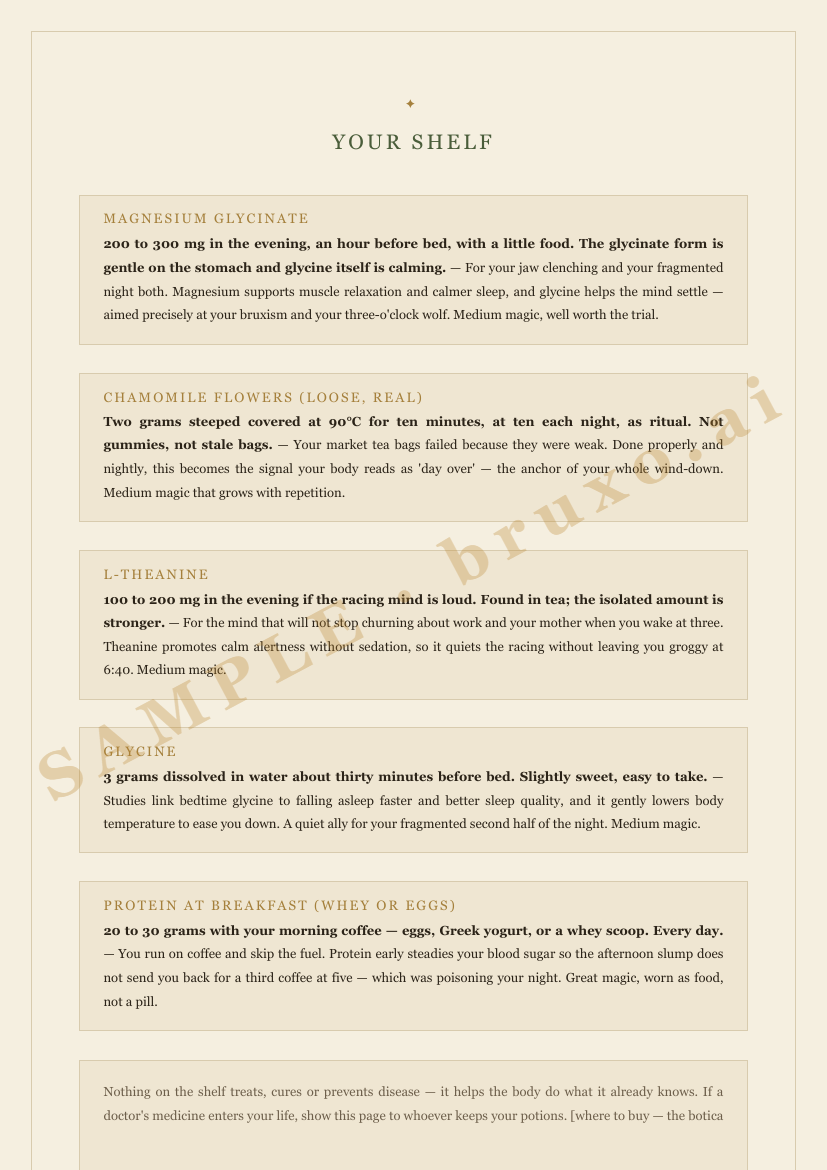 26 pages — yours will speak of you
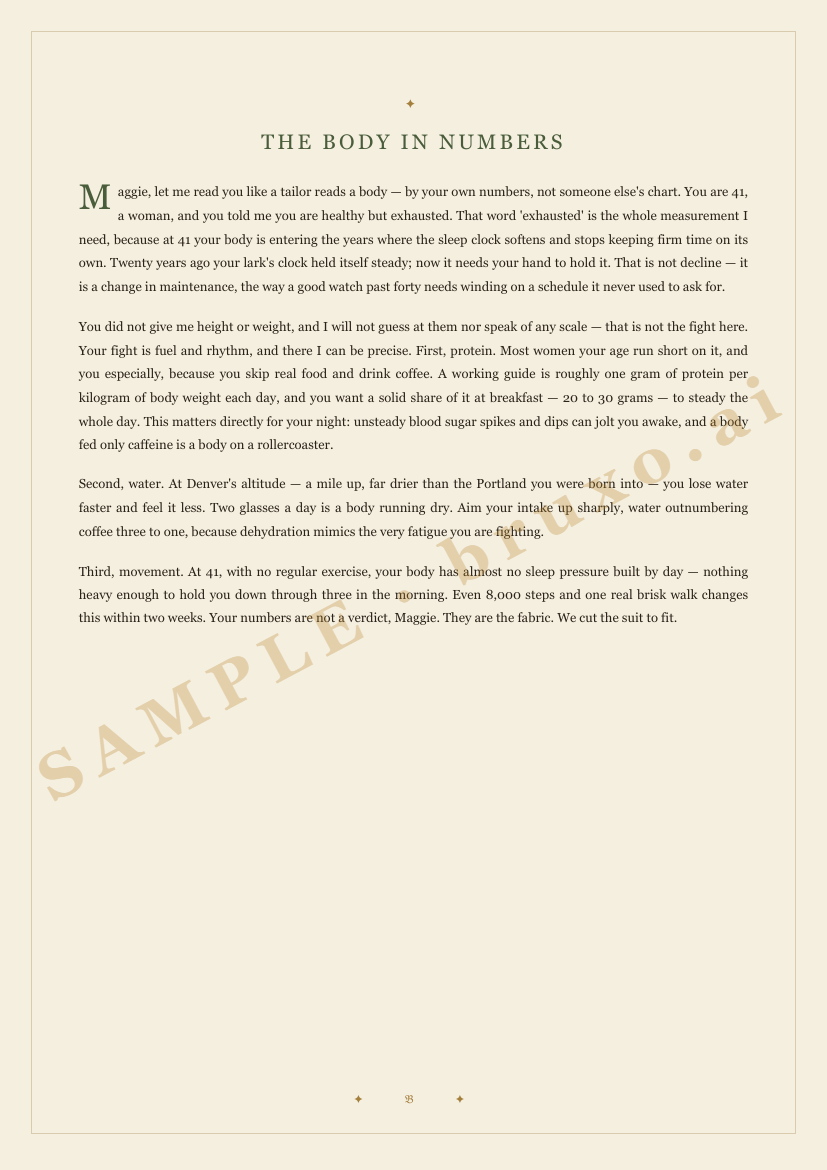 26 pages — yours will speak of you
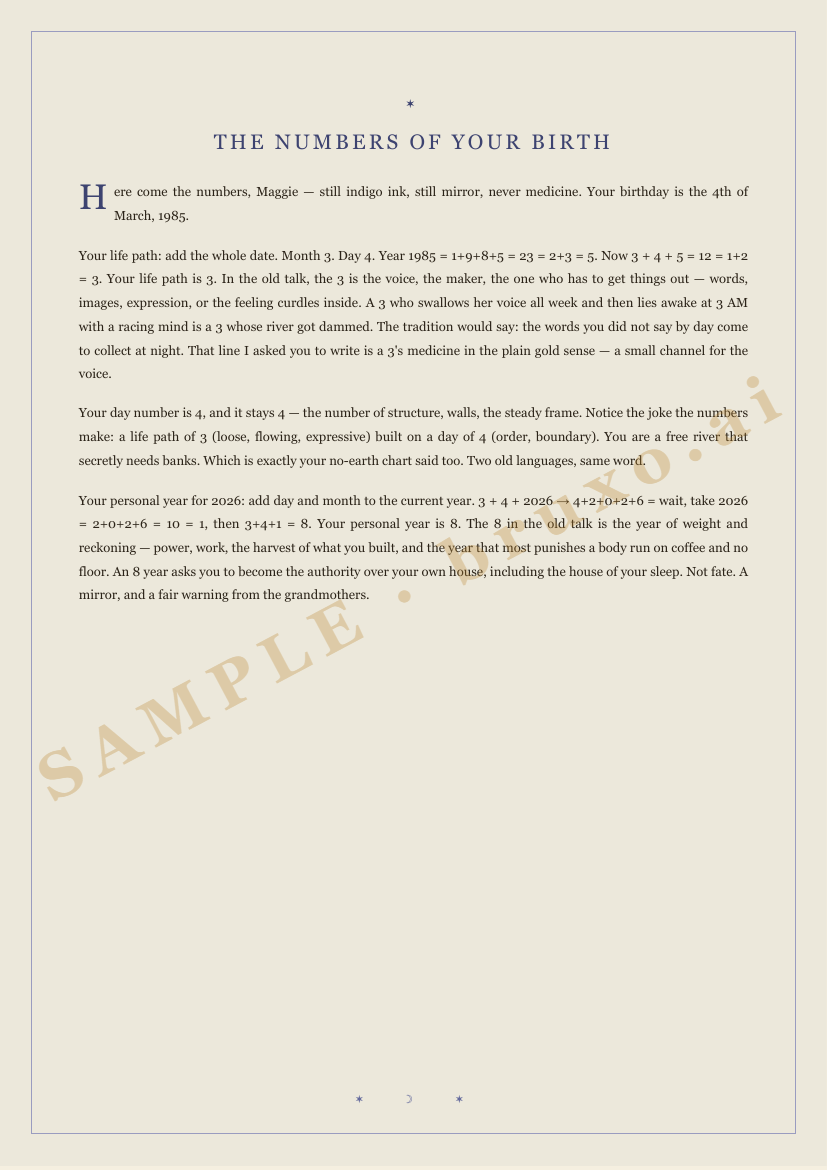 26 pages — yours will speak of you
Tap the first two to look closer. The rest stay veiled: they belong to whoever ordered them.
There is no single "magnesium". On a pharmacy shelf, that word covers at least eight different compounds — the mineral bound to eight different carriers — and they behave differently in your body. Some are absorbed well and support calm evenings. Some mostly stay in your gut and pull water in. One of them, the cheapest and most common, largely passes through you. Choosing "magnesium" without choosing the form is like ordering "a drink" and letting the bartender decide whether you drive home.
The form answers what it does. The other half of the answer is time: for rest and muscle tension, magnesium is a slow remedy. The research that found benefits measured them after weeks of daily use — not after three nights. Those two facts, form and time, explain almost every "it didn't work" story ever told about this mineral.
This page gives you both: a 3-click decision tree that names your form, your dose and your honest timeline — and, below it, the full shelf with the evidence for each jar.
Bioavailability differs sharply by form: in a comparative study of commercial magnesium preparations, oxide showed roughly 4% absorption while citrate and chelated forms performed far better (Firoz & Graber 2001; Walker 2003). In a randomized trial with older adults, 500 mg daily for 8 weeks improved measured sleep quality — note the timescale: weeks (Abbasi 2012, n=46).
The old herbals called magnesium-rich waters "the quiet springs" — places where travelers slept deep and woke soft. It is a story, told as a story. The measurable part lives in the gold ink above.
You bought "magnesium". Two weeks later: nothing.
Here is how it usually goes. Someone tells you magnesium helps with rest. You walk into a pharmacy, pick up the bottle that says Magnesium in the biggest letters at the smallest price, take it for five nights, feel nothing, and quietly add it to the drawer of things that don't work.
Nobody at the counter told you there were eight forms behind that one word. Nobody told you the bottle you grabbed — almost certainly oxide, because oxide is what the biggest-letters-smallest-price bottle contains — sends most of its magnesium straight through you. And nobody told you that even the right form needs two to three weeks of showing up daily before it has anything to show you. You didn't fail the remedy. The label failed you, twice.
The fix is not another generic list of "best magnesium supplements". It is three questions about your case — what you want it for, how your stomach behaves, and whether a doctor needs the first word. Three clicks. Then you know.
The fact nobody tells you (and why "magnesium did nothing for me")
Two numbers explain almost every abandoned bottle.
First: 2–3 weeks. Magnesium is not a sleeping pill and does not behave like one. It is a mineral your body uses in hundreds of slow processes; when your levels are low, refilling them takes days, and noticing the difference takes longer. The clinical trial that found better sleep measures in older adults ran for eight weeks (Abbasi 2012). Nobody in that study would have reported anything at day five. Yet day five is exactly when most people give up — the bottle goes to the drawer, and the verdict "doesn't work" gets written on a remedy that was never given time to speak.
Second: ~4%. That is the approximate absorption measured for magnesium oxide, the form in most of the cheapest, most visible bottles (Firoz & Graber 2001). Oxide packs a lot of elemental magnesium per pill — which makes the label look generous — but most of it never crosses into your blood. It stays in the gut, pulls in water, and leaves. That is genuinely useful if slow transit is your complaint. For rest, it is a jar of mostly nothing.
Put the two together: the average frustrated buyer took the least absorbed form for a quarter of the minimum honest trial period. The mineral never had a chance.
When someone tells me "magnesium did nothing", I ask two questions: which form, and for how long? Nine times out of ten the answer is oxide, five days. I keep oxide in the botica too — on the low shelf, for the occasional lazy gut, where it earns its keep. But selling it for rest? That I won't do. The jar would work harder as a paperweight.— the bruxo, from the apothecary
The six jars on the shelf
Every form is the same mineral holding a different hand. The hand decides where it goes, how much arrives, and what it does on the way. Here is the honest shelf — with the size of each jar's magic declared.
Glycinate
Bound to glycine, itself a calming amino acid. Well absorbed, and the gentlest form on digestion — the usual first choice when the goal is unwinding at night. If the tree sent you here, it sent you to the quiet jar.
Citrate
Well absorbed and cheap for what it delivers — the best value on the shelf. Pulls some water into the gut, which is the point if your transit drags, and the drawback if it doesn't. If stools turn loose, lower the dose or switch to glycinate.
Malate
Bound to malic acid, a molecule your cells use to make energy. Decently absorbed and easy on the gut. The evidence for "energy" specifically is thinner than glycinate's for rest — the strongest case is simply refilling a low tank, in the morning instead of at night.
L-Threonate
Marketed for memory and the mind because it raised brain magnesium in rodent studies (Slutsky 2010). In humans the evidence is young and small. It may earn its price someday; today you are paying a premium for a promising rodent.
Chloride & sulfate, on the skin
Sprays and salt baths promise absorption through the skin. A scientific review looked for proof and found it doesn't hold up (Gröber 2017). The honest part: a 20-minute warm bath before bed is a fine wind-down ritual all by itself. Credit the bath, not the salt.
Oxide
The cheapest jar and the most common one on shelves, with roughly 4% absorption (Firoz & Graber 2001). For rest it is the great disappointment machine. Its one honest job: an occasional nudge for a lazy gut, at the lowest price.
The whole shelf in one table
| Form | Absorption | Best for | Typical dose (elemental) | Gut effect | Relative price |
|---|---|---|---|---|---|
| Glycinate | High | Rest, tense evenings, cramps | 200–400 mg, dinner | Gentlest | $$ |
| Citrate | High | Slow transit, all-round | 200–400 mg, evening | Loosens | $ |
| Malate | Good | Daytime energy | 200–400 mg, morning | Mild | $$ |
| L-Threonate | Good (brain data: animal) | "Brain" claims — young evidence | ≈145 mg, split | Mild | $$$$ |
| Chloride/sulfate (skin) | Unproven through skin | The bath ritual itself | — | — | $$–$$$ |
| Oxide | ~4% | Occasional slow transit only | 250–500 mg, occasional | Loosens strongly | $ |
"Elemental" magnesium is the number that counts — check the label, because "1000 mg of magnesium citrate" is not 1000 mg of magnesium.
How to know it's actually helping: the 3-week diary
Magnesium's changes are quiet, and memory is a bad witness for quiet changes. So don't trust memory — keep a scrap of paper by the bed and write three things each morning, thirty seconds total:
- Night wakings: how many times, and roughly when.
- Cramps or restless legs: yes or no.
- Evening tension, 1–5: how wound-up you felt after dinner.
The honest signs, when they come, look like this: falling back asleep faster after a waking; shoulders and calves letting go earlier in the evening; the 1–5 number drifting down. What magnesium will not do is knock you out — it is not a hypnotic, and any bottle promising that is lying about the mineral or hiding something else in the blend.
At the end of week 3, compare against week 0. Clearly better? You found your form — keep it. Nothing at all? Then magnesium was probably not your bottleneck, and that is worth knowing too: your night may be asking for something else — light, timing, caffeine, or a mind that won't close its tabs. Stop paying for the wrong answer.
Food first: the bruxo prefers the table to the capsule
Before the jar, the plate. Magnesium is not rare — it sits in ordinary food, and food comes with its own escort of fiber and cofactors that no capsule matches. The dense sources, roughly per handful or square:
- Pumpkin seeds — the crown: ~150 mg per small handful (28 g).
- Spinach and chard, cooked — ~75–80 mg per half cup.
- Dark chocolate, 70%+ — ~50–65 mg per square (28 g). Yes, the wizard prescribes chocolate; before dinner, not at midnight.
- Almonds and cashews — ~75–80 mg per handful.
- Black beans, lentils — ~60 mg per half cup, cooked.
- Avocado — ~40–45 mg each.
A dinner with greens, seeds and beans covers a large share of the day's need before any supplement enters the story. If your plate already looks like that and your nights are still wired, that is precisely when a capsule — the right one — has something to add.
I'll tell you what the capsule sellers won't: half my magnesium consultations end with a shopping list, not a supplement. Pumpkin seeds are cheaper than any premium jar and taste better than all of them. And the other half of honesty — I don't know your case from here. A tree sorts the forms; it doesn't know that you drink three coffees after lunch. That's what the chair across from me is for.— the bruxo, from the apothecary
Closed doors: interactions, and when this is a doctor's matter
Magnesium is sold without a prescription, but it is not free of rules. These doors the botica keeps closed, and says so out loud:
- Quinolone and tetracycline antibiotics (ciprofloxacin, doxycycline and family): magnesium binds them in the gut and can blunt their effect. If you must take both, separate them by at least 4–6 hours — and tell your doctor.
- Bisphosphonates (bone medication such as alendronate): same binding problem, same rule — hours apart, doctor informed.
- Kidney function: magnesium leaves the body through the kidneys. If yours are not fully healthy, excess can accumulate — supplementation is a medical decision, not a shelf decision.
- High doses = diarrhea. Above roughly 350 mg of supplemental elemental magnesium, loose stools become common. That is not a detox, it's not "working hard" — it is the body returning the excess. Lower the dose.
- Pregnancy, breastfeeding, children: through the doctor's door, always.
And the honest boundary of the whole page: magnesium supports normal rest and muscle relaxation. If you haven't slept properly in months, if your legs kick every night, if tiredness is crushing regardless of sleep — those are conversations for a physician, not a mineral. In this botica the doctor is the spine of the remedy; everything here hangs from it.
Why there are no glowing reviews here
Pages like this usually end with a wall of five-star miracles. This one doesn't, on purpose. The botica is new, and we do not invent people. When real readers run the 3-week diary and tell us what happened — including the "it did nothing, turns out my problem was coffee" stories — they will appear here, failures included.
Until then, our credo is the guarantee: gold ink only over claims with a source you can click; indigo ink for legend, declared as legend and never dressed as science; and no promise, ever, that a mineral fixes a life. That is the whole trick, and it isn't one.
Questions that reach the apothecary
Which magnesium is best for sleep?
How long does magnesium take to work?
What's the difference between glycinate and citrate?
Does magnesium oxide work?
Can I take magnesium every day?
From the same shelf
- Melatonin or magnesium: which one your night is actually asking for
- Tea for sleep: the seven jars the bruxo actually brews
- Herbs for the stress hormone: a 24-hour walk through the day
- The birth chart calculator: where your Map begins
So now you know which magnesium fits the night — which form crosses into calm and which one just passes through.
But a page like this can only speak in general — it describes the night, not yours. Which hours run strong in your own body, which remedy fits your constitution — that reading starts from your birth data, and it is the Map of the Body: 26 pages written on your chart alone, yours for good.
The night has been explained. Yours is still waiting to be read.
Open my Map — $13.40Secure checkout by ClickBank · 60-day guarantee · no rush: the apothecary door doesn’t close.